 Decks
Home › Games › Pyramid Solitaire — rules, levels and strategy
Pyramid Solitaire: pairs that make thirteen
Pyramid is the solitaire of arithmetic rather than sequence. Twenty-eight cards lie face up in a triangle of seven rows; you remove them in pairs that add up to thirteen. It is quick, it is unusually easy to learn, and it is harder to win than it looks.
Pyramid with four, two or one redeal of the stock. Free to download; daily game limit without Premium.

 Scan with your phone to install
Rules of Pyramid Solitaire
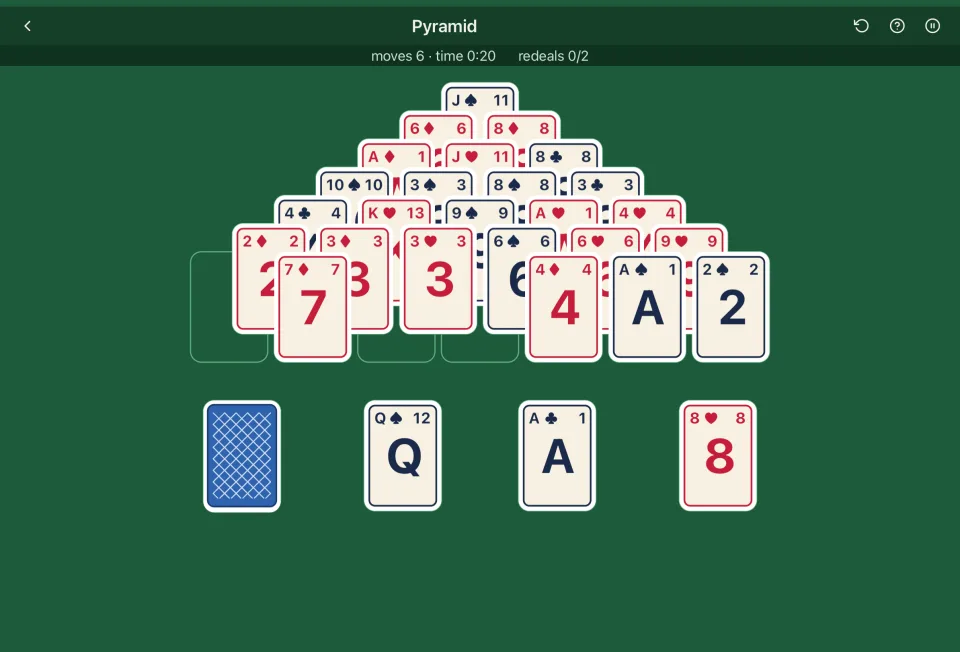
The layout. Twenty-eight cards are dealt face up in seven rows — one card in the first row, seven in the last — each row overlapping the one above. The remaining twenty-four cards form the stock.
Availability. A card is available while no card of the row below covers it. At the start only the seven cards of the bottom row can be played.
Pairs. Take any two available cards whose ranks add up to thirteen: an ace counts one, a jack eleven, a queen twelve, number cards their face value. A king is thirteen on its own and leaves alone. The top card of the waste may be one half of a pair. Only the top card of the waste can be used; the card under it becomes available once the top card has gone.
The stock. Out of moves, turn a card from the stock onto the waste. When the stock is empty it may be redealt — how many times depends on the level.
Winning. Clear the pyramid. Cards left in the stock and waste do not matter.
The three levels
Pyramid in Decks differs by how many times the stock may be redealt:
- Easier — the stock may be redealt four times.
- Classic — twice.
- Hard — once.
Everything else — the pyramid, the pairs, the king — stays the same.
Strategy
- Read the top of the pyramid first. The single card at the apex and the two below it decide the game: if their partners are buried under them, the deal is lost before it starts. Knowing where the partners are tells you the order of work.
- Kings first, always. A king costs nothing to remove and frees a card beneath. There is never a reason to wait.
- Prefer pyramid-to-pyramid pairs. Pairing a pyramid card with the waste removes one card from the triangle; pairing two pyramid cards removes two.
- Count partners. Each rank has four partners that make thirteen. If three of the four sixes are already gone, the last seven is in trouble — take it while a six is available.
- Use the stock sparingly on the first run through it. While the stock can still be redealt, a card you skip comes round again; once the redeals are used up it does not. On Hard, with a single redeal, every turn of the stock is a decision.
- Uncover before you clear. A move that exposes a new pyramid card is worth more than a move that only tidies the waste.
Pyramid in Decks
Three levels, a rules page one tap away, undo without penalty, and a history of every round with its deal code. No ads, no account, works offline. Free to download; daily game limit without Premium.

Frequently asked questions
How do you play Pyramid Solitaire? Remove pairs of uncovered cards that add up to thirteen; kings leave alone. Turn the stock when stuck. Clear the pyramid to win.
What do the cards count? Ace 1, two to ten face value, jack 11, queen 12, king 13.
Can you use the waste pile? Yes — the top card of the waste can be one half of a pair.
How many times can the stock be redealt? Depends on the level: four times on Easier, twice on Classic, once on Hard.
Is every Pyramid game winnable? No — some deals are impossible from the start.
Pyramid with four, two or one redeal of the stock. Free to download; daily game limit without Premium.
Scan with your phone to installAlso in Decks
- Black Hole Solitaire — rules and strategy
- Double Klondike — two-deck solitaire with nine columns
- FreeCell Solitaire — rules, moves and strategy
- Golf Solitaire — rules and strategy
- Klondike Solitaire — rules, five levels and strategy
- Memo — the memory card game, four sizes
- Spanish Solitaire — Klondike with a 40-card Spanish deck
- Spider Solitaire — 1, 2 and 4 suits
- Tower of Hanoi — with cards, three or four places, plus Two Towers
- TriPeaks Solitaire — rules and strategy
- Yukon Solitaire — rules and strategy