 Decks
Home › Games › Memo — the memory card game, four sizes
Memo: the memory card game
Memo is the memory game everyone has played at a kitchen table — cards face down, open two, keep the pairs — done with playing cards instead of pictures. Each card has a twin of the same suit and rank. The whole game is attention: where was the seven of hearts, three turns ago?
Memo with four board sizes, from ten pairs to twenty-six, and no ads between rounds. Free to download; daily game limit without Premium.

 Scan with your phone to install
Rules of Memo
The board. Cards lie face down in a grid. Every card has exactly one twin — same suit, same rank — somewhere on the board.
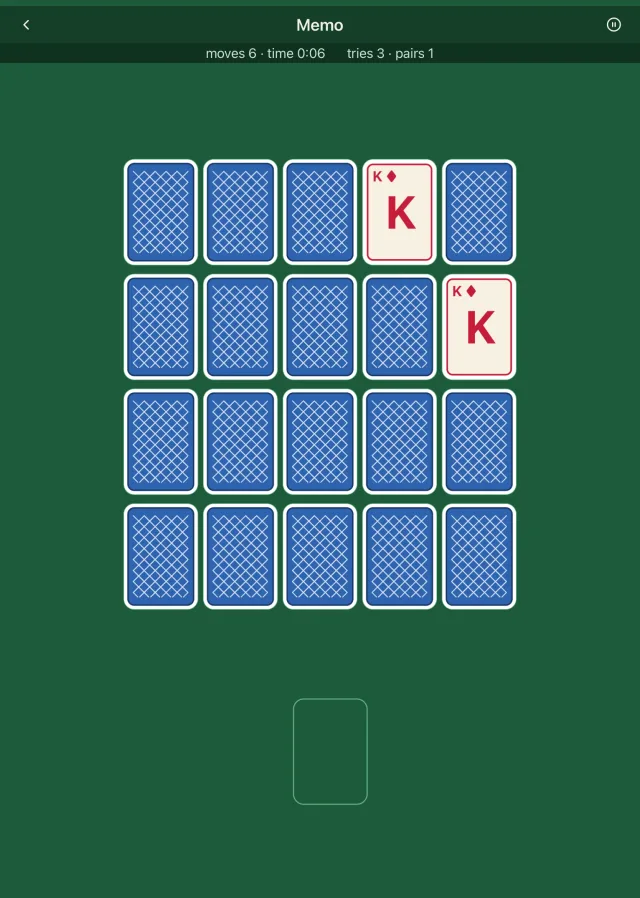
A turn. Tap a card to open it, tap a second card to open that. If they match, both stay open and leave the board. If they do not, the table closes them again — and you are expected to remember where they were.
Winning. Open every pair. The score is the number of tries: one try is two cards opened. Fewer is better; a try can complete at most one pair, so no game takes fewer tries than there are pairs.
Four board sizes
| Board | Grid | Pairs |
|---|---|---|
| Small | 5 × 4 | 10 |
| Medium | 6 × 5 | 15 |
| Large | 7 × 6 | 21 |
| Full | 8 × 7 (the last row has four cards) | 26 pairs — 52 cards |
The small board is a warm-up; the full board — fifty-two cards face down — is the hardest board.
Why a memory game with cards
Pictures on memory tiles are easy to name and easy to confuse: two cartoon cats look alike at a glance. Playing cards are the opposite — a rank and a suit are exact, so what you remember is precise, and there are up to twenty-six pairs to hold in mind on the largest board. That precision makes it a game of strategy rather than luck.
Strategy
- Open unknowns first. When you have no known pair, open two cards you have never seen. Opening a known card as the first of a turn wastes information.
- Second card: known or unknown? If the first card's twin is known, take it. If not, open another unknown — every new card is information for later.
- Remember by position, not by order. "Bottom row, third from the left" survives longer in memory than "the card I opened after the queen".
- Work in regions. Clearing one corner before moving on keeps the number of remembered positions small.
- Do not rush. The score is tries, not seconds: the clock on the table counts, it does not judge. A slow correct turn beats a fast wrong one.
Memo in Decks
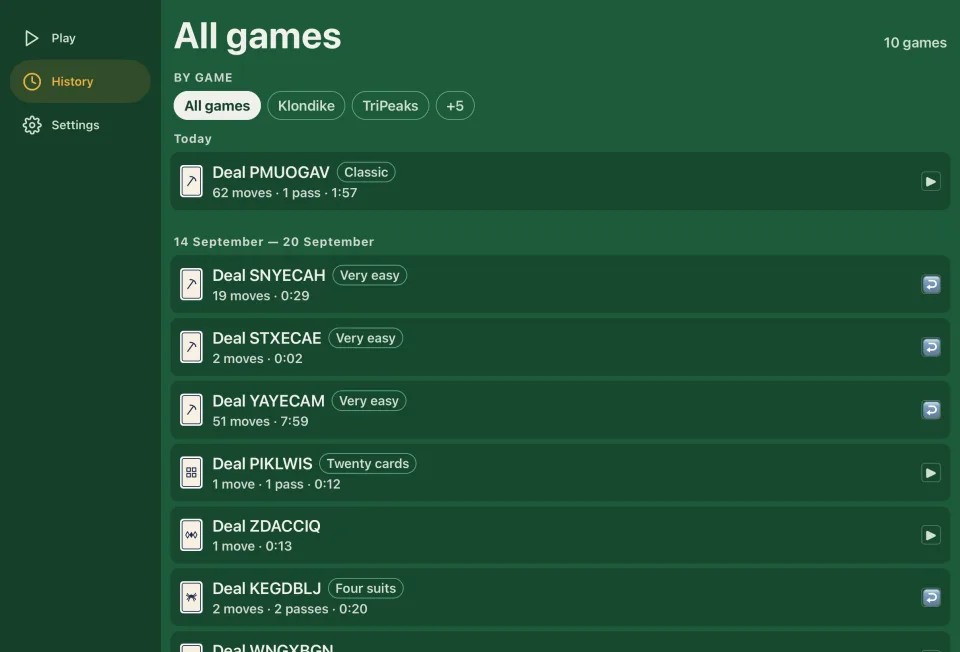
Four board sizes chosen on the game card, each with its own best score, and a history of every round. No ads, no account, works offline. Free to download; daily game limit without Premium.
Frequently asked questions
How do you play the memory card game? Cards face down; open two per turn; matched pairs stay, mismatches close. Clear the board in as few tries as you can.
Is Memo hard? The rules take a minute; the small board is a comfortable start and the full board of twenty-six pairs is demanding.
How many cards are on the board? From twenty (ten pairs) to fifty-two (twenty-six pairs), depending on the size you pick.
Is there a timer? The table shows elapsed time, but the score is the number of tries.
Memo with four board sizes, from ten pairs to twenty-six, and no ads between rounds. Free to download; daily game limit without Premium.
Scan with your phone to installAlso in Decks
- Black Hole Solitaire — rules and strategy
- Double Klondike — two-deck solitaire with nine columns
- FreeCell Solitaire — rules, moves and strategy
- Golf Solitaire — rules and strategy
- Klondike Solitaire — rules, five levels and strategy
- Pyramid Solitaire — rules, levels and strategy
- Spanish Solitaire — Klondike with a 40-card Spanish deck
- Spider Solitaire — 1, 2 and 4 suits
- Tower of Hanoi — with cards, three or four places, plus Two Towers
- TriPeaks Solitaire — rules and strategy
- Yukon Solitaire — rules and strategy